To find AI opportunities, a business owner can start with a description of the business and a few real examples of how work gets done. The goal of the first stage is to choose one task whose value can be measured.
The article includes the full Centre SM business map as a PDF. Its four sheets are also available below as images.

1 Give AI the context
Gather a description of your products, customers, order stages and systems. Add your website, examples of requests, documents and typical questions. Use confidential information only in a service approved by the company.
Prompt: “Study my company materials. Describe how we make money, whom we sell to and how we fulfil orders. Separate facts from assumptions. Ask questions about missing information.”
2 Build a process map
Prompt: “Break the business down into processes. For each one, specify the input, actions, result, owner and systems used. Show how products, information and money move through the business. Do not suggest automation yet.”
Review the map with employees. It is important to reflect how work is actually done, including exceptions and manual actions.
3 Look for opportunities from different angles
Prompt: “For each process, find opportunities for improvement in the following areas. State the suspected problem and a question that would validate it.”
- Money: purchasing terms, discounts, costs and losses.
- Speed: queues, approvals and manual processing.
- Customers: answers, recommendations, additional and repeat sales.
- Quality: errors, omissions and inconsistent data.
- People and knowledge: re-entering data, finding instructions and dependence on experts.
- Management and growth: lost tasks, handoffs between departments and increasing workload.
Ask AI to add known automation practices to the list. Do not limit the search to bots or to cost savings alone.
4 Validate the problems
For promising tasks, ask employees how often they occur, how much time they take, where errors happen and what is already automated. Look at real examples.
Record the findings in a table: process → problem → evidence → frequency → consequences.
For example, the existence of estimates does not by itself mean that AI is needed. The basis for a project is a confirmed difficulty in processing them.
5 Choose a solution approach
Prompt: “For each confirmed problem, suggest options: process change, conventional automation and AI. Compare the required data, integrations, constraints and employee involvement.”
Common types of AI solutions:
- Bots: answer questions, clarify requests and hand them over to a manager.
- Documents: extract data, match line items and prepare drafts.
- Knowledge bases: find instructions and answer with links to sources.
- Calls and messages: record agreements and tasks in the CRM.
- Sales: suggest bundles and repeat purchases.
- Voice input: turn messages into statuses and tasks.
- Analytics: find deviations and explain results.
- Agents: perform several related actions within defined permissions.
Use formulas and rules for calculations and unambiguous checks. AI is useful when the task requires understanding text, speech or an ambiguous request.
6 Choose one pilot
Compare tasks by expected value, data availability, complexity, maintenance cost and employee readiness. Do not ask AI to invent a return on investment: provide real numbers or ask it to list the missing ones.
For the pilot, define one process, an owner, the boundaries of automation and a success metric.
7 Measure the effect
Before launch, measure execution time, errors or another selected metric. Test the solution on real examples, including difficult cases. Repeat the measurements while accounting for the time needed to review and correct the results.
Expand the solution after its value has been confirmed. Keep the instructions, integrations, verification examples and rules for handing work over to a person inside the company.
The logic is: expand the list of problems → choose a confirmed one → consider solution approaches → test one pilot.
Example: the Centre SM business map
The example of a building-materials seller shows what this approach produces. Based on the website, we identified private customers, contractors and developers, as well as stores that purchase goods for resale.
Prompt used to reproduce the analysis — formulated from our research, not a verbatim quote:
Study https://tdcsm.ru/. Build a map of how the company purchases goods, whom it sells to and through which channels, how it handles an enquiry and fulfils an order. Separate product, information and money flows. Mark confirmed information and hypotheses. Divide the map into four parts: business model, procurement, sales and fulfilment. Then suggest automations by money, speed, customer experience and quality. Put the suggestions in separate notes and do not mix them with the business processes.
The resulting map, in brief:
| Part | What the map showed |
|---|---|
| How the company makes money | Suppliers → purchasing and fulfilment → private customers, builders and stores. Money flows from customers through the company to suppliers |
| Procurement | Need → assortment selection → comparison of terms → supplier order → receiving and updating product data |
| Sales | Enquiry → clarification of the need → selection from a list or estimate → quotation → order approval |
| Fulfilment | Picking → delivery or collection → receipt. Then settlements, handling claims when necessary and repeat orders |
Details of internal operations were marked as hypotheses to validate.
The full four-sheet map with ten automation hypotheses is available in the PDF file:
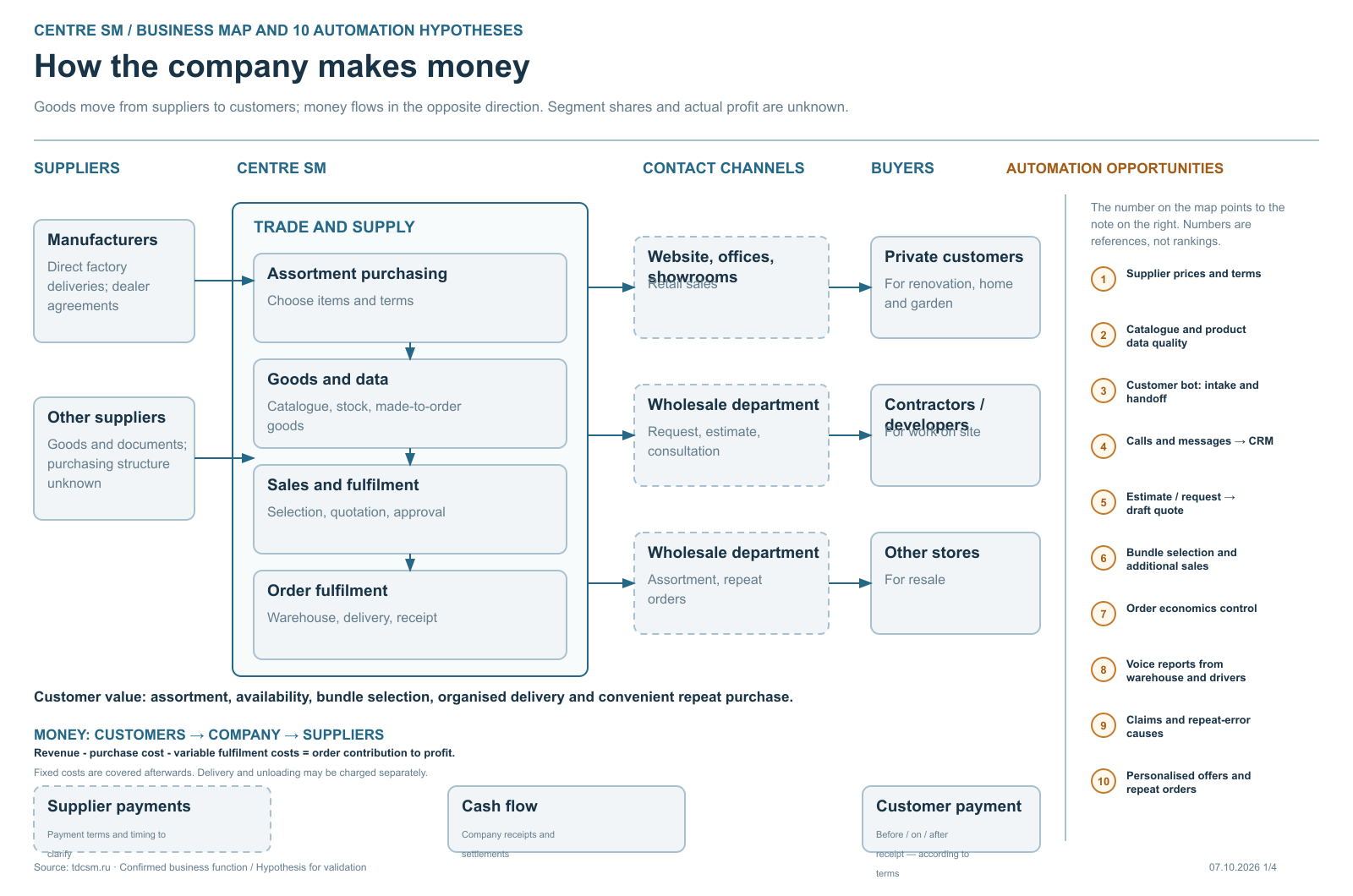
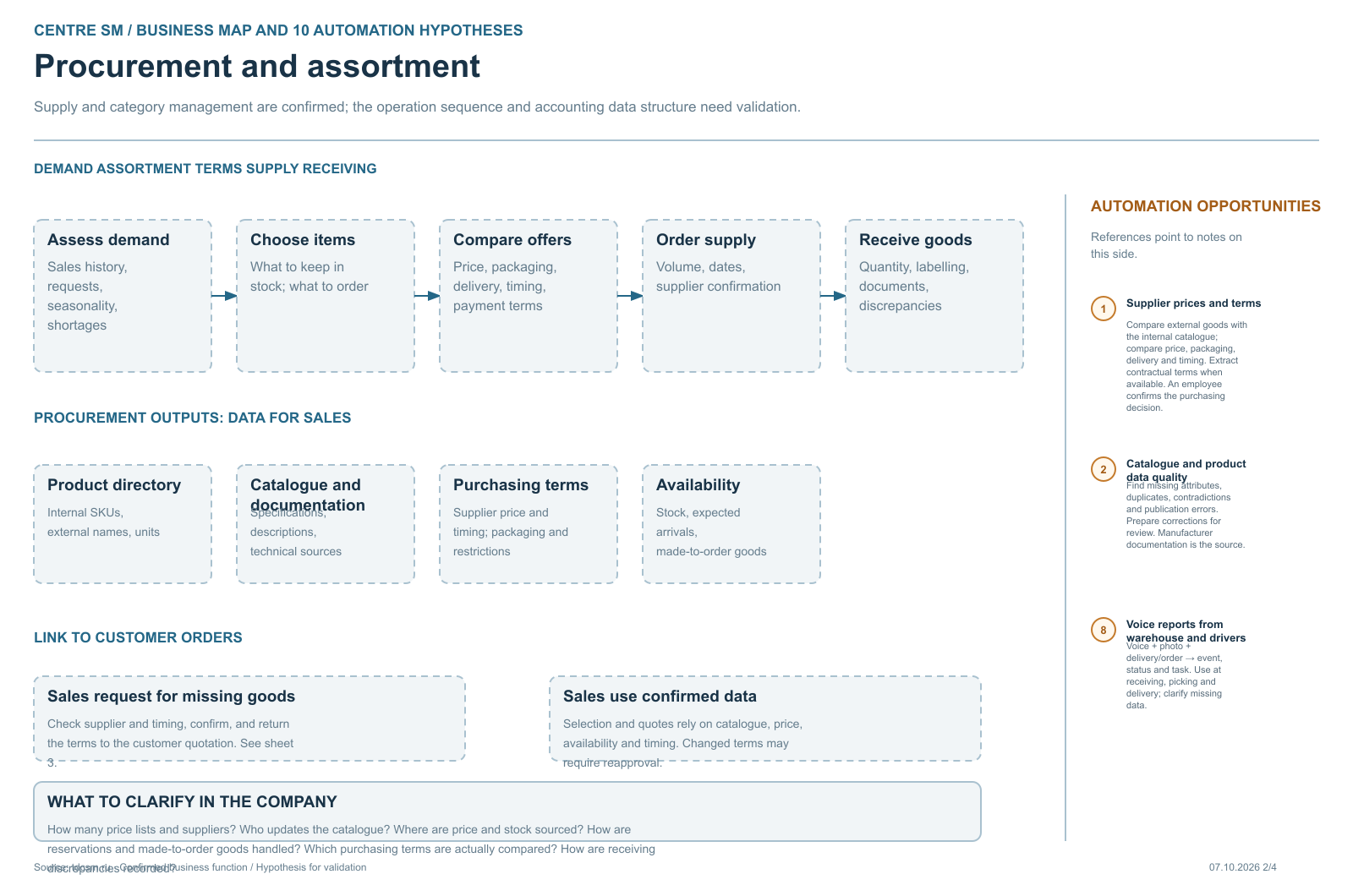
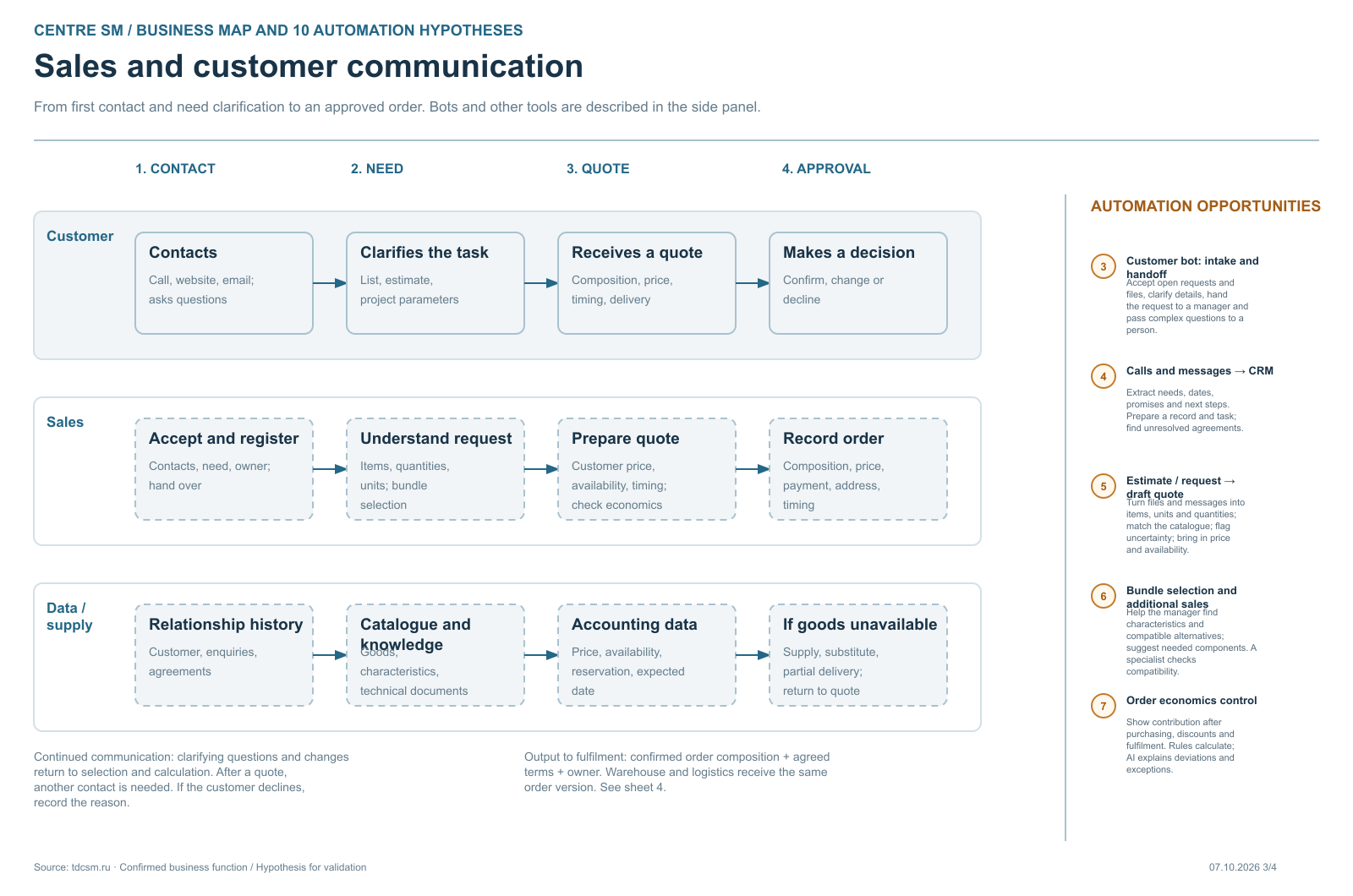
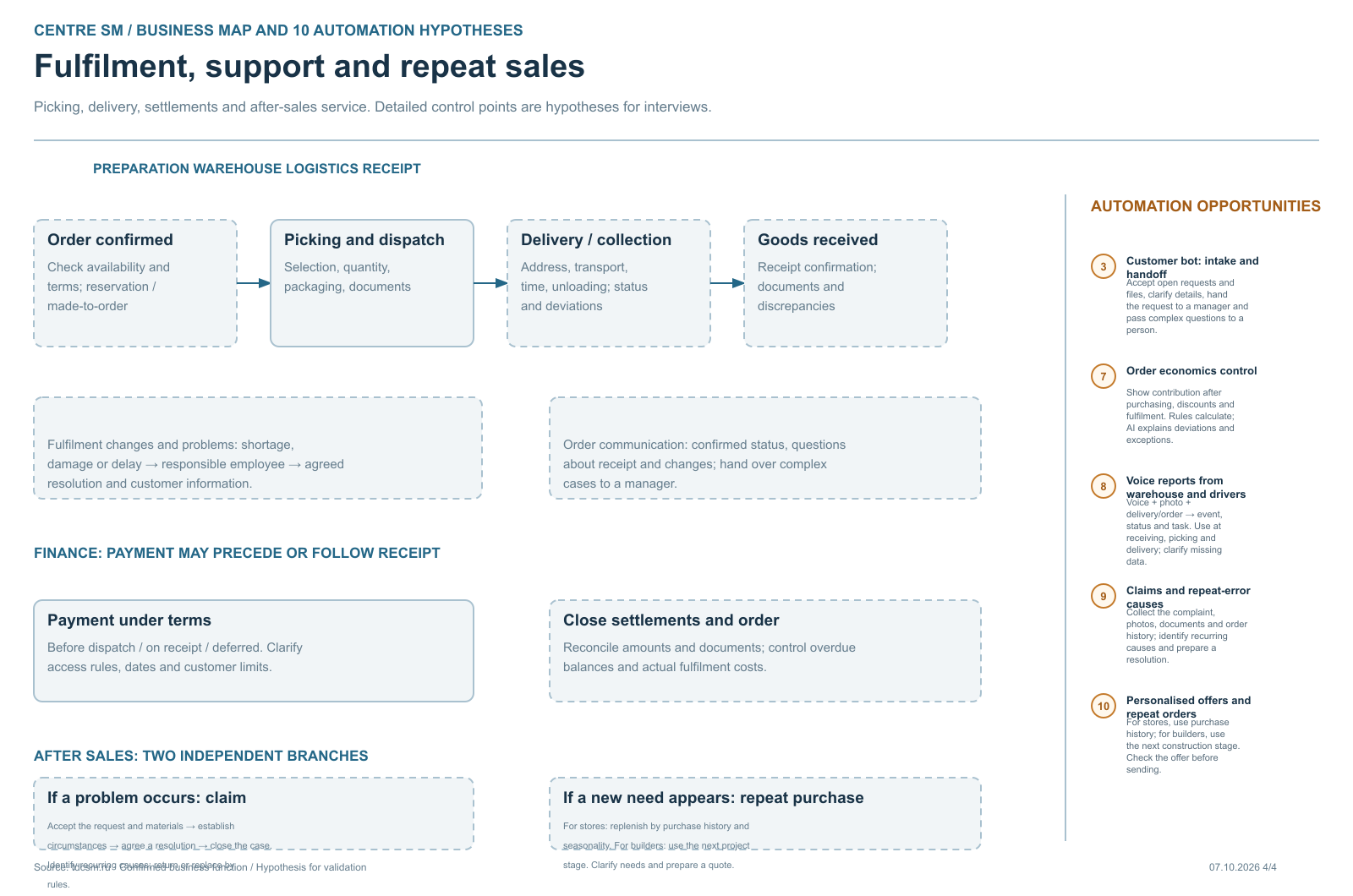
The map produced concrete directions: estimate → draft quotation, enquiry → bot with manager handoff, price lists → comparison of supplier terms.
To choose the first project, find out the volume of operations, processing time and error frequency. For estimates, for example, measure the time needed to prepare a quotation and check the accuracy of product matching on real documents.