This article looks at how the product manager role is changing and whom to hire for an AI product:
- Why the role is changing.
- What job postings expect from an AI product manager.
- How to assess a candidate.

Why the role is changing
With coding agents, a prototype can be assembled in hours; it used to take weeks. Building a feature has become cheaper, so more time goes into deciding which problem to take on and how to check whether it produced an effect. Companies are looking for product managers who own that choice and the business outcome.
Agents write more and more of the code, and manual coding is becoming a specialised niche. It is more important to understand the business problem, decide when to ship and collect feedback.
This creates demand for a product manager who can formulate requirements quickly, understand the business and its users, and validate the result before handing it to development.
What job postings expect from an AI product manager
I reviewed 50 AI Product Manager and Product Owner vacancies on hh.ru on 12 October 2026. Employers expect a strong product foundation and an understanding of AI capabilities and limitations.
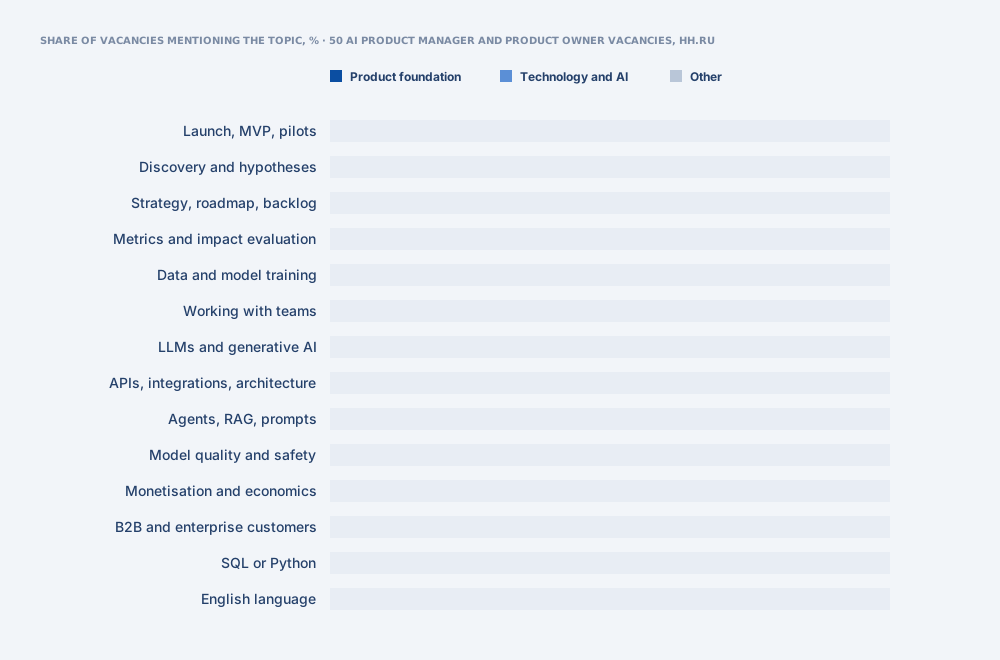
Launch, problem and demand discovery, strategy and metrics appear in almost every vacancy. Employers need a full-cycle product manager: someone who can find a problem, validate demand, launch a pilot, bring it into regular use and measure the impact. Managing a backlog is not considered an outcome by itself. The sample is targeted: it shows which expectations recur, not the share of skills across the entire market.
The second group of requirements concerns AI itself. Employers expect product managers to:
- choose tasks where AI can create useful impact;
- evaluate answer quality on reference sets of examples and analyse errors, including hallucinations — facts invented by the model;
- understand the capabilities and limitations of LLMs, agents, RAG (searching a knowledge base and generating an answer from it) and integrations;
- design a handoff to a person when AI makes a mistake (fallback);
- control answer accuracy, data security, request cost and response time;
- drive adoption: train users and make regular use of the tool possible.
The depth of technical requirements varies. Some employers explicitly say that model development is not required; others expect experience with production LLM applications. The common minimum is understanding the architecture well enough to set tasks and accept the result. A candidate’s ability to build a prototype themselves on a no-code platform, in n8n or with coding agents is a plus.
How to assess a candidate
Employers look at cases, personal contribution and measurable impact. Ask for two or three cases and examine each using the same framework:
- Problem and user: what hurt and for whom.
- Hypothesis and the candidate’s role: what they tested and what they did themselves.
- Solution: why AI and this approach were chosen, and what data and integrations were needed.
- Quality and economics: how answers were evaluated, what happened to errors and how much one scenario costs.
- Result: the stage (prototype, pilot or production use), how many people use it and what the impact is in metrics.
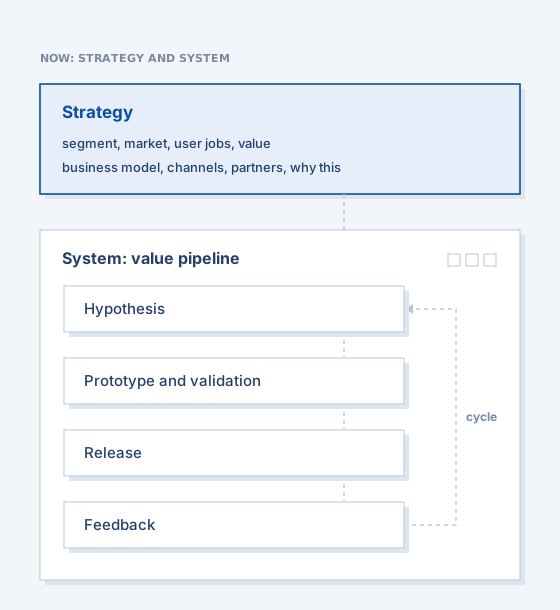
A good sign is when a candidate can show artefacts: a system or agent diagram, a set of quality checks, metrics from before and after launch, and a cost calculation for a scenario. Plans for scaling do not count as results.
In short, look for someone with a strong product foundation who can evaluate and improve the quality of an AI product.