A Technical Product Manager is responsible for product value while being able to participate deeply in its technical implementation.
The role connects three areas:
- user and business needs;
- product decisions and metrics;
- architecture, data, and engineering.
This person does not necessarily manage employees. Their job is to manage the product and make decisions at the intersection of business and technology.
How the role differs from a Product Owner
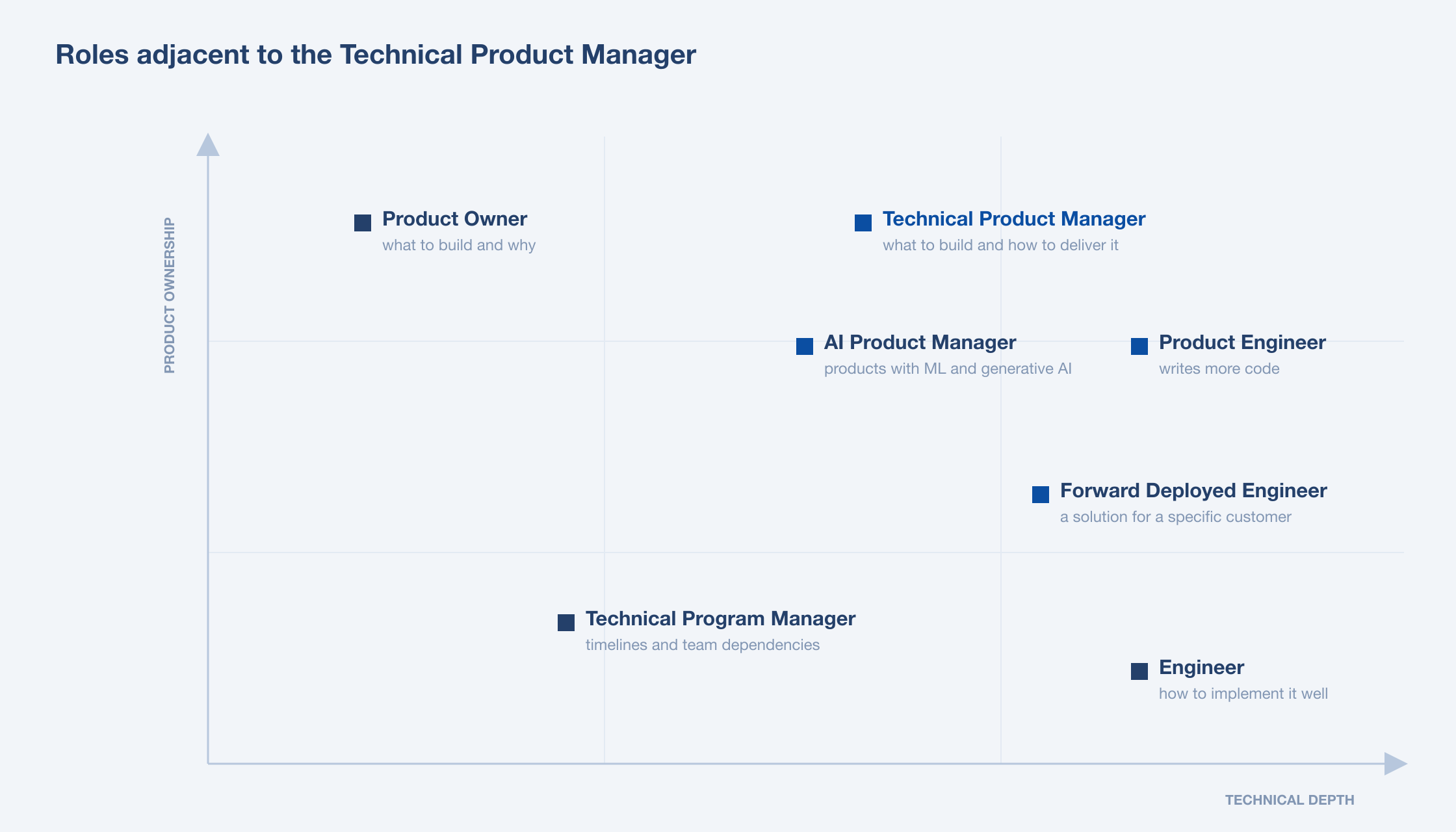
A conventional Product Owner determines what the team should build and why. They research needs, shape the backlog, set priorities, describe scenarios, and evaluate outcomes using product metrics.
A Technical Product Manager does all of this but can also discuss:
- solution architecture;
- APIs and integrations;
- data models;
- infrastructure constraints;
- security and reliability;
- operating costs;
- technical risks;
- AI model quality and evaluation methods.
They do not simply hand a business request to developers. They participate in finding a technically viable solution.
How the role differs from an engineer
An engineer is primarily responsible for how to build the system: writing code, designing components, fixing defects, and ensuring technical quality.
A Technical Product Manager is responsible for which problem is worth solving, for whom, and what outcome the business should achieve.
They may also build prototypes, write code, run SQL queries, and inspect logs. Their primary output, however, is not the amount of code written but a working product with measurable impact.
| Role | Primary question |
|---|---|
| Product Owner | What should we build, and why? |
| Technical Product Manager | What should we build, and how do we turn it into a technically viable product? |
| Engineer | How do we implement the chosen solution well? |
What a Technical Product Manager should be able to do
Product skills
- research user needs;
- formulate product hypotheses;
- define success metrics;
- shape strategy and a roadmap;
- manage the backlog and priorities;
- assess economic impact.
Technical skills
- understand web services, APIs, databases, and integrations;
- discuss architecture with engineers;
- account for security, performance, and reliability;
- interpret logs and data and investigate failures;
- build working prototypes;
- understand development and operating costs.
For AI products, this also includes LLMs, RAG, agents, context, evaluation datasets, response quality, latency, and generation cost.
Organizational skills
- translate business problems into technical solutions;
- decompose work;
- define requirements and acceptance criteria;
- negotiate trade-offs among value, time, and complexity;
- coordinate engineering, design, analytics, and infrastructure;
- support launch, adoption, and continued product development.
Role names used in the market
Companies use different titles:
- Technical Product Manager;
- Technical Product Owner;
- AI Product Manager;
- Platform Product Manager;
- Product Engineer;
- Product-minded Engineer;
- Solutions Product Manager;
- Technical Product Lead.
These are not exact synonyms. A Product Engineer usually writes more code, a Platform Product Manager develops a platform for other teams, and an AI Product Manager specializes in products involving machine learning and generative AI.
A Technical Program Manager is a different role. They usually manage a program of work, timelines, and dependencies across teams without necessarily owning the product itself.
How it differs from a Forward Deployed Engineer
A Forward Deployed Engineer, or FDE, works directly with a customer: learning their processes, designing a solution, and helping take it to production.
For example, in Anthropic’s current job listings, these engineers embed with strategic customers and build applied AI systems for specific business problems. Product scoping, stakeholder management, and value measurement are assigned to the adjacent Technical Deployment Lead role.
The main difference is emphasis:
- a Technical Product Manager owns product development;
- a Forward Deployed Engineer owns the technical solution in a specific customer context;
- a Technical Deployment Lead owns the organization of that deployment and its business outcome.
When a team needs a Technical Product Manager
The role is useful when:
- the product is technically complex;
- many integrations are required;
- business and engineering struggle to understand one another;
- the product involves AI, data, or platform architecture;
- solutions must be validated quickly with working prototypes;
- the product manager depends too heavily on the technical team for every hypothesis test;
- engineers build high-quality features whose value to users is unclear;
- adoption, operations, and outcome measurement become difficult after launch.
Who can grow into this role
Technical Product Managers usually come from one of two starting profiles:
- A product manager who develops technical depth in architecture, APIs, data, code, and operations.
- An engineer who develops product thinking in research, metrics, prioritization, economics, and stakeholder work.
The clearest sign of readiness is the ability to independently move from an ambiguous business problem to a working technical solution and demonstrate its value with data.