What responsibilities companies assign to Technical Product Managers, what experience they expect, and what to assess when hiring.
This review is based on 11 unique IT job descriptions, including roles at YADRO, Kryptonite, VK, Uzum, Yesim, Sibedge, Bazon, and Astra Group. It represents this specific sample rather than the entire market.
What kind of role is this?
A Technical Product Manager is a product manager with a technical background who connects business needs with the structure and evolution of an IT system.
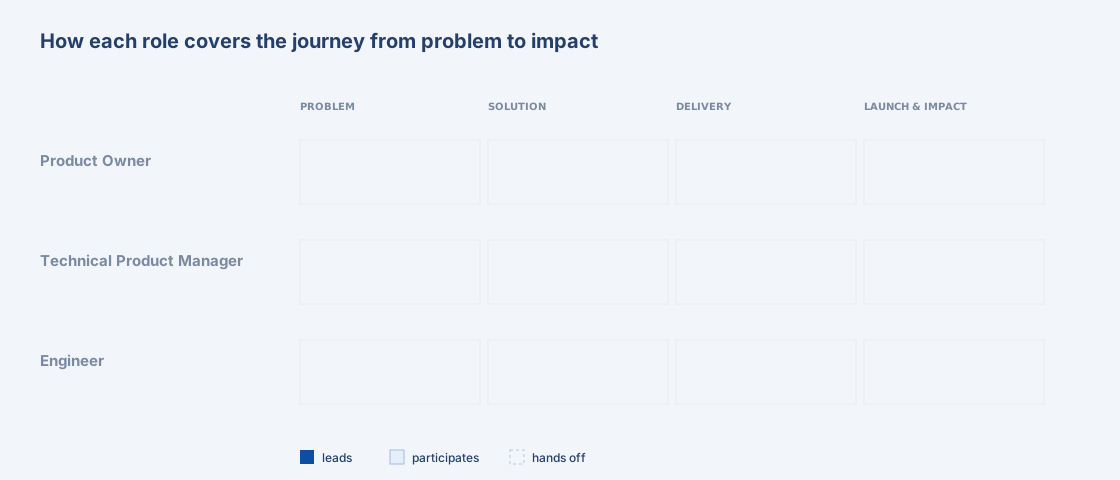
They understand the customer’s problem, determine the value of a solution, work through it with engineers, and take it to launch. After release, they evaluate the outcome and define the next improvements.
Technical work accounts for a substantial part of these vacancies: APIs, integrations, data, architectural constraints, reliability, and operations. Only a few roles require the manager to write code independently.
What responsibilities do they own?
| Area | Expected outcome |
|---|---|
| Needs discovery | User and business problems are identified; current processes and the causes of friction are understood |
| Hypothesis validation | There is sufficient evidence to proceed: research, prototypes, experiments, or data analysis |
| Product planning | Goals, a roadmap, and priorities tied to business outcomes are defined |
| Requirements preparation | Scenarios, constraints, functional and non-functional requirements, and acceptance criteria are documented |
| Technical elaboration | Integrations, dependencies, risks, and the implementation approach are agreed with engineers |
| Development coordination | Work is decomposed, teams are aligned, and blockers are identified and removed |
| Launch and growth | The solution is evaluated after release, feedback is collected, and further improvements are defined |
| Analytics | Metrics are established to assess the product’s value and quality |
The emphasis varies in practice. YADRO focuses on finding opportunities to apply AI and assessing business impact. Kryptonite emphasizes requirements, technical solutions, and delivery management. Yesim focuses on integrations and the reliability of eSIM services. VK and Uzum develop shared platforms used by multiple teams.
What skills do employers expect?
Product skills. User research, problem framing, hypothesis validation, prioritization, and metrics. A candidate should be able to explain why a feature is needed and how its outcome will be evaluated.
Technical skills. Understanding APIs, databases, integrations, and service interactions. Some positions require knowledge of microservice architecture, infrastructure, CI/CD, monitoring, and error handling. The required depth depends on the product.
Analytical skills. The ability to find problems and opportunities in data. In billing, this includes payment conversion, declines, and cancellations; in banking onboarding, funnel completion; in platform products, service adoption, data quality, and stability. Several vacancies explicitly require SQL.
Organizational skills. Managing backlogs, releases, dependencies, and the work of several teams. In some roles, the manager also runs the Scrum process. Platform teams particularly value the ability to influence development without direct administrative authority.
Communication skills. Gathering requirements, aligning solutions, giving demonstrations, and managing expectations. The manager must discuss value and processes with customers, and implementation and constraints with engineers.
What experience do employers expect?
The sample includes requirements starting at three years of product experience, while some positions ask for longer tenure. What matters is experience taking solutions to a working outcome: from research and requirements through launch and subsequent improvements.
Employers cite software development, systems analysis, architecture, engineering, QA, and technical team leadership as relevant technical foundations.
Specialized products also require experience in the relevant domain:
- payments and subscriptions — acquiring, recurring payments, and fiscalization;
- telecom — eSIM activation, providers, and network scenarios;
- anti-fraud — fraud, risk, and regulatory requirements;
- data platforms — data processing, quality, and governance;
- infrastructure software — Linux and operations;
- AI — understanding the technologies and their limitations.
Sibedge specifically asks for hands-on experience creating prototypes and automations with Claude Code, Codex, Cursor, or similar tools. This is a distinct version of the role, not a universal requirement for every Technical Product Manager.
How to define the profile before hiring
The job title does not imply one standard set of responsibilities. Start by defining the team’s primary challenge:
| Challenge | Experience to look for |
|---|---|
| Find valuable use cases and validate demand | Strong discovery, research, and prototyping |
| Prepare a complex solution for development | Systems analysis, requirements, APIs, and architectural elaboration |
| Organize implementation and releases | Development coordination, dependencies, quality, and delivery |
| Develop a platform for several teams | Internal products, shared services, APIs, and work in a matrix organization |
| Improve integrations and stability | Operations, monitoring, incidents, and external providers |
| Rapidly build AI solutions for customers | Product thinking and hands-on implementation with AI tools |
What to assess in an interview
Ask the candidate to walk through one product they delivered:
- What problem did they identify, and how did they confirm its significance?
- Which solution options did they consider, and why did they choose one of them?
- How did they prepare requirements and align technical constraints?
- How did they organize development and launch?
- Which metrics did they use to evaluate the outcome?
- What did they change after feedback or operational issues?
The main criterion is the ability to connect a problem, a technical solution, and a measurable outcome. The answers should make clear which decisions the candidate made personally and which part of the work they owned.