1. What transformation is happening and where we are heading
- The shift toward post-labor and AI-native organizations: We have moved from using AI as a simple assistant to full-scale automation of cognitive labor. A company of 10–20 people can now operate networks of hundreds or thousands of autonomous AI agents.
- The “Process as Product” concept: In AI-native organizations, traditional business processes—marketing, sales, legal work, analytics, and HR—become executable software artifacts: agent graphs, workflows, and specifications.
- The Intent Economy: Users and businesses are moving from performing manual actions step by step in interfaces to expressing goals or intentions. Agents then negotiate, compare terms, and execute the task autonomously.
- Compression of the “middle layer”: Writing code and building standard software products are rapidly losing value because of vibe coding and coding agents. The manual translation of requirements into code is shrinking toward zero; the scarce capability is a clear understanding of the problem and precise task definition.
2. Which skills are becoming critical
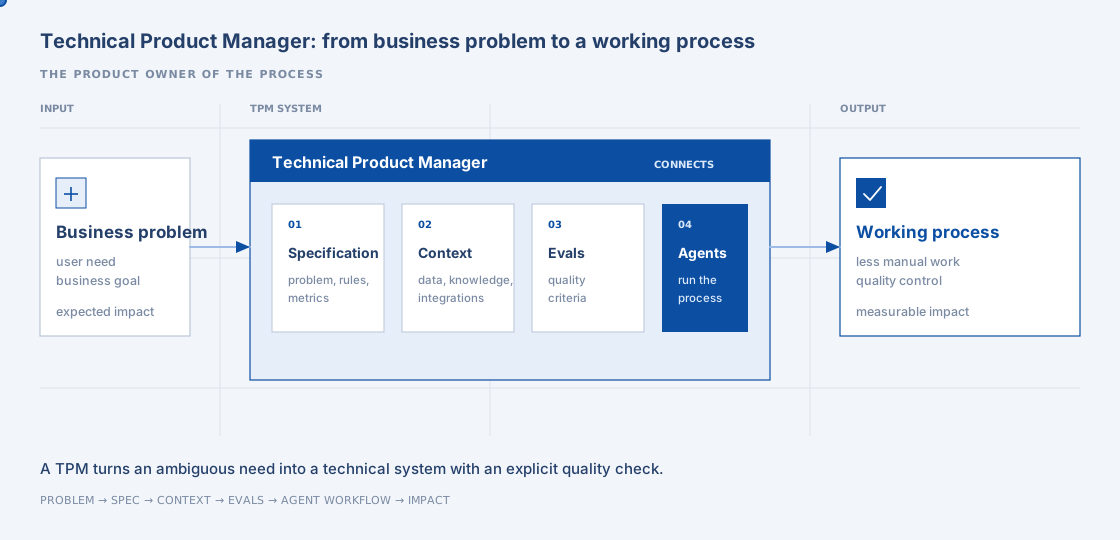
- Designing evals and specifications (Spec-Driven Development): The ability to formulate exhaustive requirements and create automated quality tests—evals—that determine whether agents have completed a task successfully and prevent the system from hallucinating or cutting corners.
- Context engineering and data architecture: Extracting a company’s tacit knowledge, codifying operating rules, building context graphs, and connecting MCP servers that provide data to agents.
- Human taste and judgement: When agents can generate thousands of code, text, or design variants in seconds, the main human value becomes the ability to filter out slop—mediocrity—and set a high quality bar.
- Orchestration and process-graph management: Decomposing complex business goals into parallel subtasks, designing guardrails, handling failure recovery, and controlling a swarm of agents.
3. Why the Technical Product Manager (TPM) is the most promising role
Among today’s roles, the Technical Product Manager (TPM) most naturally combines all the requirements of the new reality:
- A bridge between the business goal and the agent stack:
- A conventional Product Manager often lacks the technical depth to design evals, configure MCP servers, organize context graphs, or assess reliability risks.
- A pure engineer may find it difficult to keep the product and business metrics of the process in view: ROI, cost per outcome, conversion, and unit economics.
- The TPM combines both worlds: they treat the business process as a product while managing it through technical specifications and architecture.
- Product Owner for processes (Process PO): The TPM moves from managing Jira tickets to becoming a “process architect.” They define success metrics, reduce the human intervention rate, and continuously iterate the agent graph.
Main conclusion: The future belongs to specialists who can translate an ambiguous business need into an ideal specification, design an agent system around it, and define precise quality metrics. Of all existing professions, the Technical Product Manager is the closest embodiment of this function.