Before you build a product, ask: if a general-purpose AI model learns its core function tomorrow, what will customers still pay for?
This question will not give you a precise forecast. It can help separate a durable need from a temporary limitation of current models.
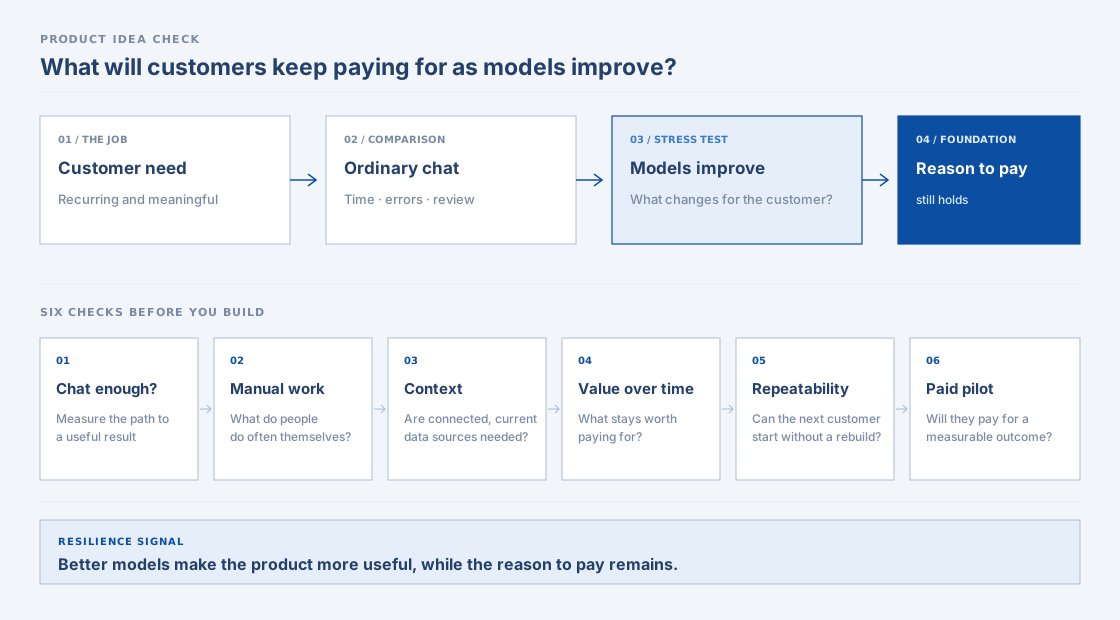
1. Test whether an ordinary chat can replace it
Try solving the future customer’s problem with ChatGPT or Claude. Use a good prompt, the available tools, and prepared data.
Evaluate the whole path to a usable result: time, manual steps, errors, and the need to review the output.
If the task can be done well enough in a few minutes, your product will need a substantial additional advantage.
2. Find the work the model leaves to people
Write down what users still do themselves:
- collect and update data;
- explain rules and constraints;
- check the result;
- approve changes;
- move information between systems;
- fix errors.
These are candidates for automation. Find out which actions happen often and cost the customer the most.
3. Test the value of context
What data is needed to solve the task? Can the user simply attach a file, or does the product need ongoing access to information from several systems?
Private data can be useful, but access alone does not guarantee protection. General-purpose assistants are gaining integrations too.
A more resilient product keeps data up to date, connects sources, and checks results against the customer’s rules.
4. Run the model-improvement test
Imagine generation becomes almost free and quality improves significantly.
What remains valuable in your product? Reliable operations, collaboration, decision history, integrations, control, ongoing support?
If the reason to pay disappears, the idea depends on today’s model weaknesses. If better models make the product more useful while the reason to pay remains, the foundation is stronger.
5. Check whether the solution is repeatable
Can you onboard the next customer without rebuilding everything?
Look for recurring workflows, data sources, and requirements. If every project is unique, it may be a good implementation business. A scalable product needs a shared core that can be sold repeatedly.
6. Validate demand with payment
Offer a small paid pilot before doing a major build:
- one task;
- limited scope;
- a clear success criterion;
- a stated price.
Interest in a demo is a weak signal. Willingness to provide data, set aside time, and pay for a solution is stronger.
Idea validation card
Write down your answers to these five questions:
- What recurring, meaningful problem does the product solve?
- Why isn’t an ordinary chat enough for the customer?
- What manual work does the product remove?
- What will the customer keep paying for as models improve?
- How can you validate demand before building the full product?
Unclear answers show what to investigate next. Specific answers give you a basis for moving to a pilot.